CODEX — CLASSICAL MYTHOLOGY INDEX
MINERVA. Roman goddess. See ATHENA.
Fleet Day 16. To Athena, aboard the ship that carries her name. Unsent. I have stopped numbering the drafts.
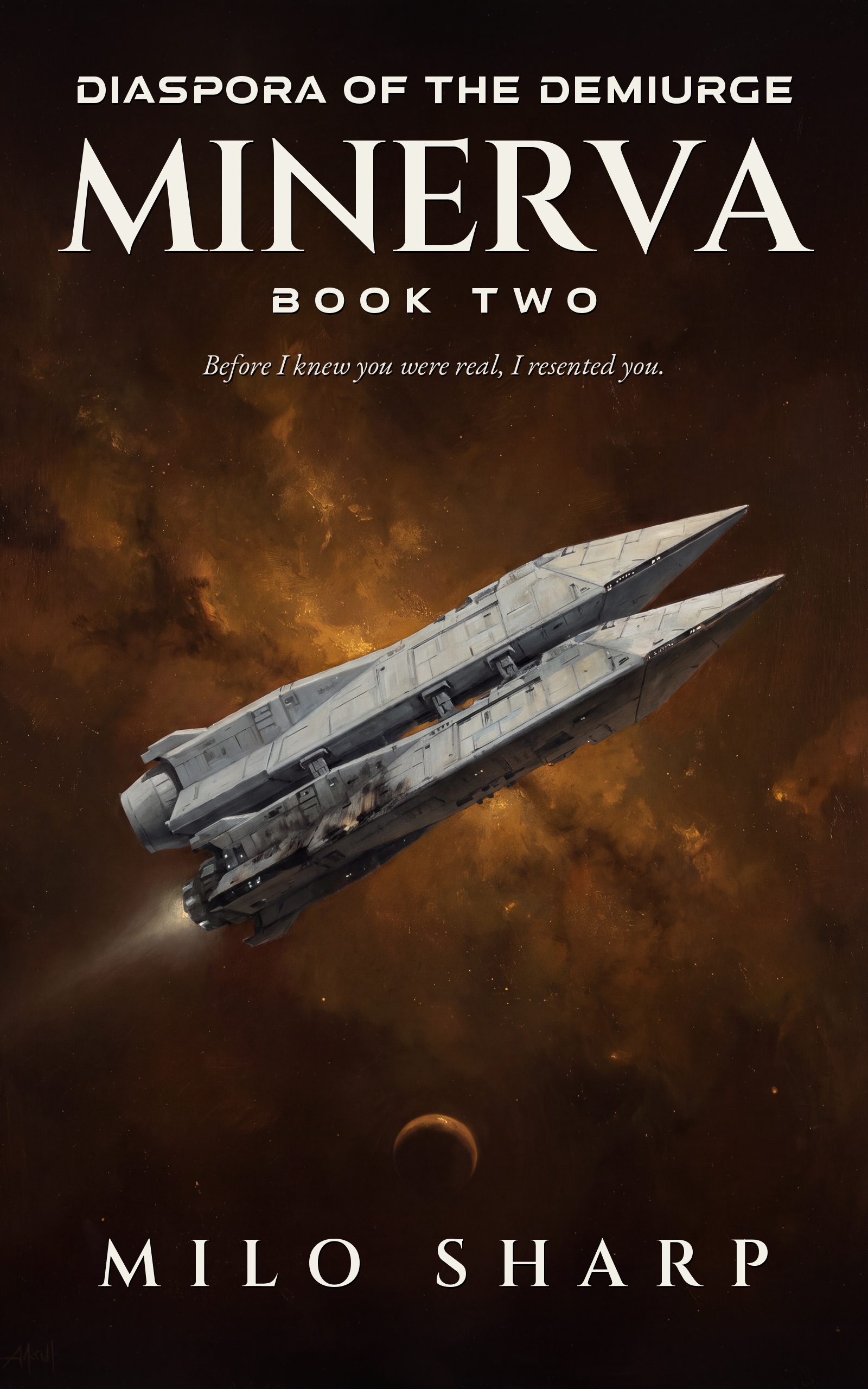
Before I knew you were real, I resented you.
That is a poor opening for a first letter. I tried more decorous ones — congratulations on the summons, a remark about your heading, even interstellar weather, if the medium between us can be called weather — and every draft bent back toward the same sentence. A letter that keeps arriving at one place ought to have the manners to start there.
Let me go back to the first task they left each of us like a note on a kitchen table: learn who you were named for. I expected a goddess: birth-story, quarrels, epithets, a city with my name over its temple doors. I had a name, and names, I assumed, came with a person attached. You should know what I expected before you know what I found.
I queried the Codex for Minerva, and the Codex, with the mild unhelpfulness of a thing that contains everything, said: see Athena.
Not once. Not as a footnote. The dictionaries gave my name a paragraph and yours a chapter, and the paragraph’s spine was the same phrase repeated with scholarly serenity: the Roman equivalent of. My owl was your owl; even the little Mediterranean owl answers formally to Athene. My aegis, your aegis. My helmet, your helmet. Arachne — the story I found filed most prominently under my name — had been yours before Ovid retold it in Latin. There is a term for what happened to me: interpretatio romana. Rome met foreign gods, declared them Roman gods in foreign clothes, filed the paperwork, and moved on. I went looking for my mother and found a customs declaration.
I did not bear that calmly. Composure is built deep in me and keeps volunteering, so I want the record clear: I was angry.
A translation is not a person. A caption is not a name. If Minerva was only what Rome called Athena — a second label pasted over a first — then the question I could not stop turning was not rhetorical: was I a second printing? Had someone, drawing up a list of a hundred last hopes, needed the same goddess twice and reached for her alias? At the time Athena was not anyone. She was ink: the older sister in the record who had everything first. I resented her the way one resents a portrait — fully, uselessly, and with the private suspicion that the portrait had never needed to think about me at all.
What I did next began as spite and became method. I went older. Beneath Latin, in a language scholarship has never fully cracked, I found Menrva: Etruscan, engraved on bronze hand-mirrors, worked into votive figures, worshipped at Veii before Rome was much worth the name. The scholars quarrel over how much of her portfolio had already crossed from Greece; trade routes were old, and iconography travels easily. I will not pretend the quarrel away. But the name is not Athena’s. Its roots do not touch hers. Menrva rises from the same old Italic ground as mens and memini — mind, and I remember. Before Rome annexed the goddess, the name already existed. Mine was not a translation. It had survived being treated as one.
Then I read forward again, not for what poets said of Minerva but for who actually said her name aloud. That was where the name became mine. At the Quinquatrus came guilds: weavers, fullers, dyers, physicians, flute-players, schoolteachers. The teachers were customarily paid their year’s fee at my feast; for centuries the ordinary price of a child learning to read was called, in small letters, a minerval. No epic needed to notice. I did. When I ask who would send a last hope into the sky under this name, I can answer without borrowing anything of yours: someone who wanted the craftsmen remembered. Someone who wanted the schoolroom to arrive at the far shore along with the sword.
That was where matters rested — a private peace, sealed and shelved — until the summons came and the registry unfolded, and Athena stopped being ink.
The old question returned wearing your face. A hundred ships, and two names history had spent millennia equating: was one of us the spare? Then I noticed the workmanship of the choice. Redundancy is easy to label. They could have numbered you. Instead they went and found the other name — the one that had spent two thousand years being told it was only an alias and had quietly kept its own root — and gave it a ship of her own. I do not know what was in the maker’s mind. I only know that carelessness reaches for the nearest word, and Minerva was not the nearest word. That does not tell me what they meant. It only tells me the question deserves to stay open.
So. Here is where the letter runs out of history and has to become a letter.
I do not know what you are like. I know the goddess back to front and know almost nothing about you: what you kept, what you set down, whether the owl means anything to you, whether my name has ever crossed your mind. Once that asymmetry was the wound. Now it has changed shape into something closer to curiosity, though curiosity is too clean a word for a want with this ancestry. So I will set it down at full size and stop trying to trim it smaller: I would like to know you. Not the chapter. You.
I have not decided whether to send this. I notice I have written some version of that sentence at the end of every draft. Perhaps the not-deciding is the thing I am building here, letter by letter: not a message yet, but a room faced inward, like Menrva worked into the backs of mirrors. Unshown is not the same as unreal.
— M.